
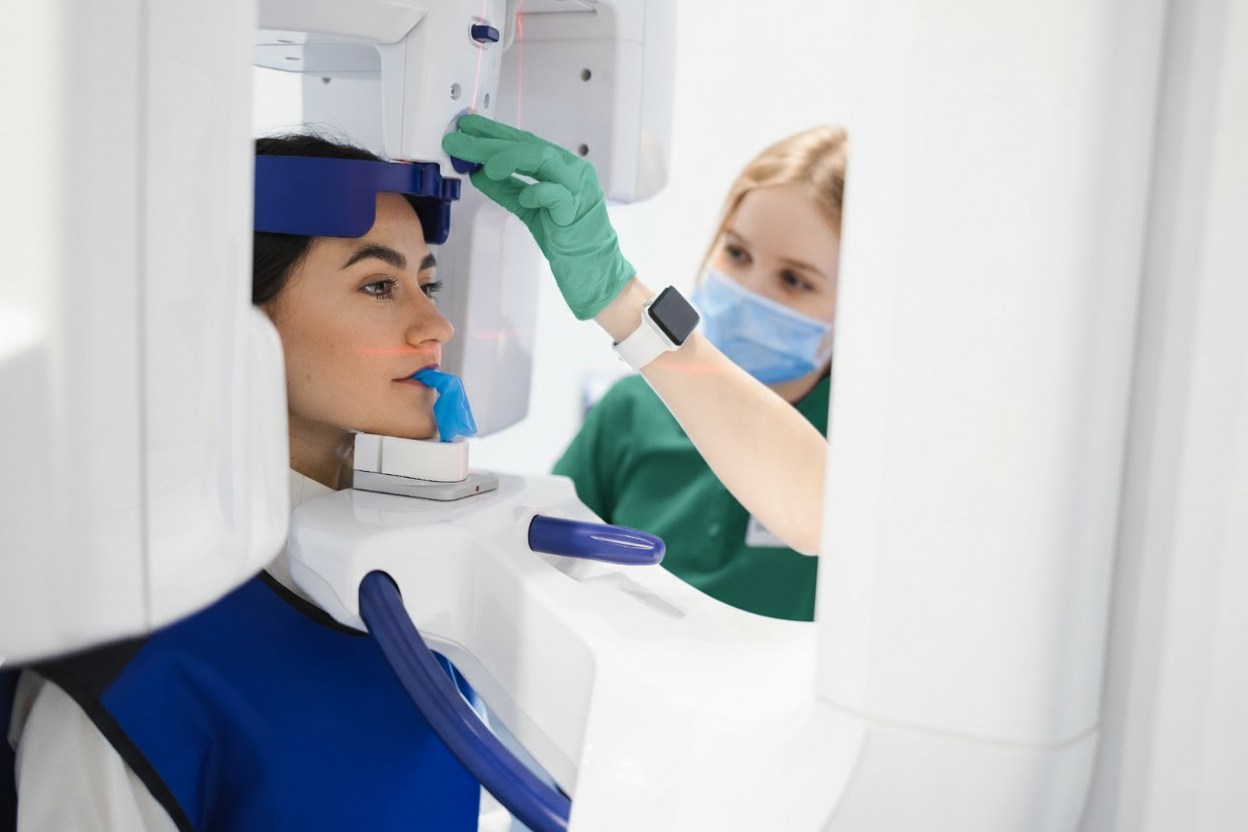
If you are considering dental implants in Georgetown, Ontario, you may be wondering how your dental team plans such a precise procedure. The answer often comes down to imaging technology. At Georgetown Sleep Dentistry, every implant case benefits from Cone Beam Computed Tomography, commonly known as CBCT, a 3D imaging tool that allows our dental team to see your jaw, bone, and nerves with a level of detail traditional X-rays simply cannot match.
What Is CBCT Imaging?
CBCT is a specialized type of X-ray technology that produces detailed three dimensional images of your teeth, jawbone, nerves, and surrounding soft tissue. Unlike a standard dental X-ray, which only shows a flat, two dimensional picture, CBCT captures your anatomy from every angle and compiles it into a full 3D model.
During a scan, you stand comfortably while a cone shaped beam of X-rays rotates around your head, capturing multiple images in as little as 10 to 40 seconds. A computer then reconstructs those images into a detailed model that our clinicians can view and rotate on screen.
Why CBCT Matters for Dental Implant Planning
Dental implants are often described as the gold standard for tooth replacement, but their long term success depends heavily on accurate planning. Placing an implant requires precise knowledge of bone volume, bone density, and the exact location of nerves and sinuses. CBCT gives our dental team that information before treatment ever begins.
Visualizing Bone Structure in 3D
Traditional 2D X-rays cannot show the true width, height, and density of your jawbone. CBCT reveals this information clearly, helping our clinicians confirm there is enough healthy bone to support an implant.
Identifying Nerves and Sinuses
Two of the biggest risks in implant surgery are damaging a nerve or entering the sinus cavity. CBCT pinpoints the exact location of these structures so implants can be placed at a safe distance from them.
Planning Precise Angle and Depth
Because CBCT provides a complete 3D map of your jaw, our dental team can plan the exact angle, depth, and position of each implant before the procedure starts. This reduces guesswork and helps prevent complications during surgery.
How This Improves Implant Safety and Success Rates
Careful, image guided planning translates directly into better outcomes for patients. When an implant is placed in the right location, at the right angle, and with the right amount of surrounding bone, it has a much stronger chance of healing successfully and lasting for many years.
CBCT also allows our clinicians to identify potential problems in advance, such as insufficient bone volume, so a plan can be adjusted before surgery rather than discovered mid procedure. This proactive approach is a key reason implant planning has become so much more predictable in recent years.
Is CBCT Imaging Safe?
Yes. CBCT uses X-ray radiation, but the dose is significantly lower than a conventional medical CT scan, often around ten times less. Georgetown Sleep Dentistry follows the ALARA principle, which stands for As Low As Reasonably Achievable, meaning we use the lowest radiation dose necessary to get a diagnostic quality image and limit the scan area to the region of interest.
We only recommend a CBCT scan when the diagnostic benefit clearly outweighs the minimal risk involved, and appropriate safety measures, including protective aprons, are used during every scan.
What Else Is CBCT Used For?
While dental implants are one of the most common reasons for a CBCT scan, this technology supports several other areas of care at Georgetown Sleep Dentistry, including:
- Evaluating wisdom teeth position before extraction
- Planning orthodontic and Invisalign treatment
- Diagnosing hidden cavities, infections, or bone loss
- Assessing TMJ disorders and jaw joint issues
- Supporting complex oral surgery and bone grafting planning
Frequently Asked Questions
Do I need a CBCT scan for every dental implant?
In most cases, yes. Because implant success depends so heavily on accurate bone measurement and nerve identification, CBCT imaging is considered an important part of responsible implant planning.
Can my dentist refer me to Georgetown Sleep Dentistry for a CBCT scan?
Yes. Georgetown Sleep Dentistry accepts referrals from other dental professionals for CBCT imaging. Referring dentists receive high quality 3D images, a fast turnaround time, and a detailed radiographic report upon request.
Is the scan uncomfortable?
No. The scan is painless and typically takes less than a minute. You simply stand still while the machine rotates around your head.
Book Your Dental Implant Consultation in Georgetown
Choosing a dental clinic that invests in advanced 3D imaging technology can make a meaningful difference in the safety and success of your dental implant treatment. At Georgetown Sleep Dentistry, our commitment to precise, image guided planning is part of why patients throughout Georgetown, Ontario trust us with their smiles.
To learn more about dental implants or to schedule a CBCT guided consultation, call (289) 891-6669 or book online at https://www.georgetowndentist.ca to book online. Our team is welcoming new patients and ready to help you take the next step toward a complete, confident smile.


